If you’re choosing between a clamshell griddle vs flat top griddle, the real question is: what kind of generation line are you running? In high-volume kitchens, seconds matter—and equipment that evacuates steps (like flipping) can change your throughput, labor needs, and consistency.
This direct covers two things in one place:
How does a clamshell griddle work (structure + cooking mechanism)
A viable, restaurant-focused comparison: clamshell griddle vs flat top griddle
Quick answer for busy buyers
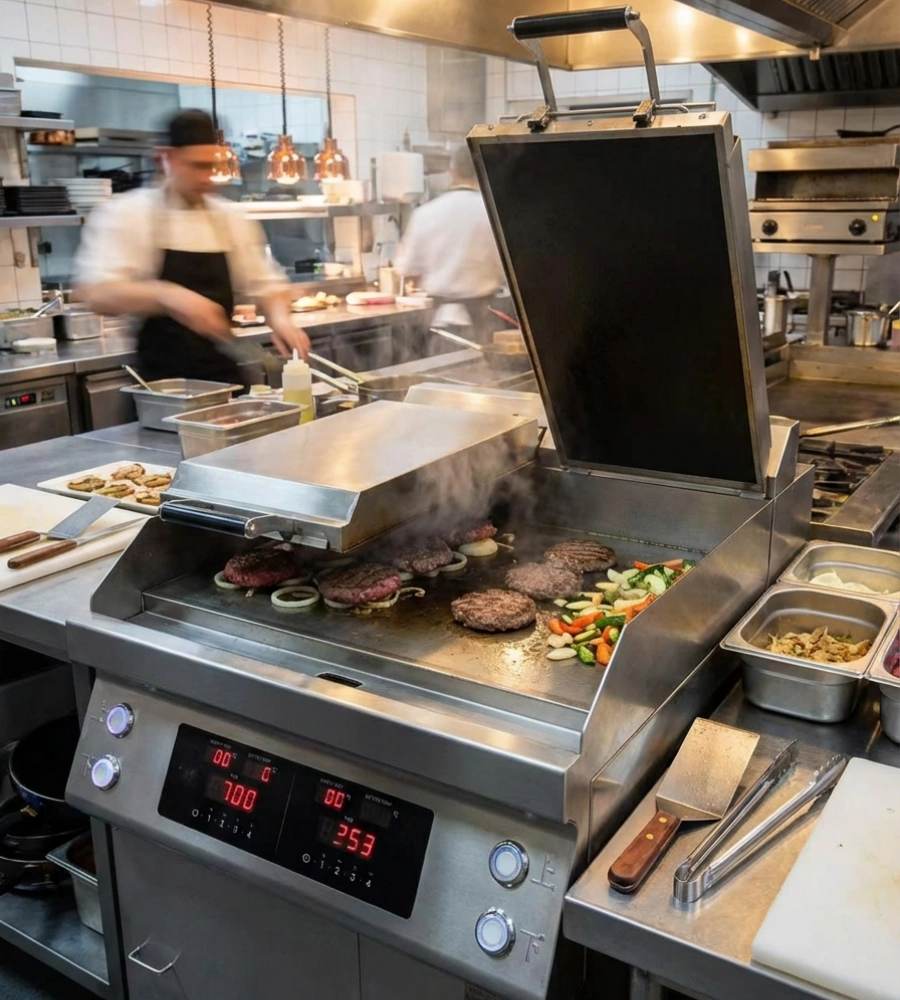
A commercial clamshell griddle cooks with heat from both the bottom and the top platen at the same time. That means:
-
Faster cook times (because both sides cook simultaneously)
-
Less labor (no flipping, fewer “touches” per item)
-
More consistent doneness (especially for proteins and sandwiches)
A flat top griddle is more flexible for mixed menus (eggs, pancakes, delicate items) but typically needs:
-
Flipping and more active attention
-
More space or more staff to hit the same peak output
What is a commercial clamshell griddle?
A commercial clamshell griddle (sometimes called a double-sided griddle or clamshell grill) is a cooking station with:
-
A lower heated plate (like a traditional griddle surface)
-
An upper heated platen that hinges down like a lid (the “clamshell”)
Instead of cooking only from below, the unit transfers heat to the food from both sides, usually through direct contact (conduction). Many models also allow you to control:
-
Upper and lower temperatures independently
-
The gap/clearance (so you don’t crush thicker items)
-
Timers and cooking presets for repeatability
How does a clamshell griddle work? Upper + lower heating structure
SEO keyword: how does a clamshell griddle work
A clamshell griddle works by combining two heated surfaces into one synchronized cooking system.
1) Bottom plate: the base heat source
The lower plate functions like a standard griddle:
-
It’s preheated to a set temperature
-
Food is placed directly on the surface
-
Heat transfers from metal → food quickly and evenly
This is your “foundation” heat: it sears, browns, and builds texture.
2) Top platen: the second heat engine
The top platen is a heated surface mounted on a hinge (often with a counterbalance system). When you lower it onto the product:
-
The top surface transfers heat into the food from above
-
The product receives heat from both sides simultaneously
-
Thickness becomes less of a limiting factor than on a single-sided griddle
3) Contact cooking + controlled pressure (optional)
Many clamshell griddles apply light, controlled contact. This isn’t about smashing food—commercial units are designed so the platen can rest evenly across the surface. In practice this:
-
Improves heat transfer
-
Helps cook thicker products more uniformly
-
Reduces “cold spots” caused by uneven contact
Good models provide an adjustable height/gap so you can set the platen to touch without compressing.
4) Independent heat zones
In high-volume kitchens, zone control matters. Some clamshell griddles split the platen and/or base into zones so you can run:
-
One side hotter for searing
-
One side cooler for holding or finishing
-
Different products simultaneously without cross-interference
Bottom line: A clamshell griddle is essentially a two-sided heating system engineered for speed and repeatability under rush conditions.
How synchronized cooking improves ticket times in high-volume kitchens
The biggest operational advantage is synchronization: cooking from two sides reduces steps and variability.
Why two-sided cooking is faster
On a flat top, a typical protein workflow looks like:
-
Place product
-
Wait
-
Flip
-
Wait
-
Pull and rest/assemble
On a clamshell griddle:
-
Place product
-
Close platen
-
Pull and assemble
You remove an entire action (flip) and reduce “babysitting.”
Why this increases throughput
In a rush, bottlenecks happen when:
-
A cook has too many items that require flipping at different times
-
Products cook unevenly, forcing re-cooks or longer holds
-
Training differences create inconsistent results across shifts
A clamshell griddle helps by:
-
Standardizing cook steps (place → close → open)
-
Shortening cook time per batch
-
Freeing staff attention for assembly, plating, QC, and replenishment
Consistency = speed, too
Even if the time savings per item feels small, the real win is reduced variability:
-
Fewer late flips
-
Fewer overcooked batches
-
Fewer “I’m not sure if it’s done” delays
That’s how clamshell systems keep lines moving in high-volume service.
Compared to a single-sided flat top griddle: where the efficiency comes from
When comparing clamshell griddle vs flat top griddle, efficiency typically comes from four areas:
1) Time-to-done (especially for proteins)
Because both sides cook at once, clamshell units often finish items faster in real kitchen conditions. Exact savings depend on:
-
Product thickness
-
Starting temperature (fresh vs chilled)
-
Target internal temperature
-
Platen contact quality and heat recovery
But operationally, two-sided heating usually means shorter cycles for burgers, chicken, and hot sandwiches.
2) Less labor per item
Flat top output is labor-limited during rush:
-
Each product needs flips and attention
-
Timing is manual
-
“Too many items at once” causes quality drops
Clamshell reduces touches:
-
Less flipping
-
Easier training
-
More predictable cadence
3) Space efficiency
A clamshell griddle can deliver higher output per footprint because it effectively doubles heat application without doubling floor space. If your line is tight, that matters.
4) Repeatability across locations
For multi-unit operations, you don’t just need speed—you need the same burger and the same doneness everywhere. Clamshell-style cooking is easier to standardize than a purely manual flat top process.
Real-world applications in fast food and chain kitchens
Clamshell units shine in menus with repeatable, high-turn items such as:
-
Burgers (fresh or frozen patties)
-
Chicken breasts / cutlets
-
Breakfast proteins (sausage patties, certain bacon programs depending on setup)
-
Grilled sandwiches (paninis, melts, breakfast sandwiches)
-
Some vegetables (when consistent thickness and contact are controlled)
In quick-service and chain environments, clamshell-style equipment is popular because it supports:
-
High throughput during peak windows
-
Consistent results with variable staffing
-
Simplified training and station workflow
Why customers prefer clamshell structure?
For buyers (dealers, franchise groups, commissaries, multi-unit restaurants), clamshell preference usually comes down to operations + ROI, not novelty.
1) Higher output with the same headcount
When labor is tight or expensive, equipment that reduces steps pays off quickly. Clamshell cooking turns a skilled timing task into a simpler repeatable process.
2) More consistent product quality
Consistency affects:
-
Customer satisfaction
-
Returns and refunds
-
Brand reputation
-
Online reviews
Clamshell cooking reduces “operator variance,” which is a major pain point in multi-shift kitchens.
3) Easier training and faster onboarding
High turnover? Seasonal staff? Clamshell systems are easier to standardize:
-
Close the platen
-
Follow timer cues
-
Assemble
Less reliance on “feel” and experience.
4) Better process control for food safety programs
While you still need proper thermometers and procedures, a stable cooking process helps kitchens consistently hit internal temp targets. That matters in audited operations.
5) Predictable speed during rush
Buyers often value “rush-proof” equipment: tools that keep output stable when things get hectic.
Clamshell griddle vs flat top griddle: side-by-side comparison
| Factor | Clamshell Griddle | Flat Top Griddle |
|---|---|---|
| Heating | Top + bottom simultaneously | Bottom only |
| Speed for proteins | Typically faster | Typically slower (flip required) |
| Labor/attention | Lower (fewer touches) | Higher (timing + flipping) |
| Consistency | High repeatability | Depends more on operator skill |
| Menu flexibility | Best for repeatable items | Excellent for mixed & delicate items |
| Best for | Burgers, chicken, sandwiches | Eggs, pancakes, toast, mixed items |
| Footprint efficiency | High output per space | May need more surface area for same output |
| Cost | Often higher upfront | Often lower upfront |
| Cleaning | Two surfaces to clean | One main surface to clean |
Which is better for restaurants?
There isn’t one winner—there’s a best fit.
Choose a clamshell griddle if you:
-
Run high-volume burger/chicken/sandwich production
-
Need faster ticket times with limited labor
-
Want consistency across shifts or locations
-
Sell a tight menu where repeatability matters more than flexibility
Choose a flat top griddle if you:
-
Serve a wide variety of items (breakfast-heavy menus, diner-style cooking)
-
Cook delicate foods that don’t like top contact (e.g., pancakes, certain fish)
-
Want maximum “open surface” control for sautéing, toasting, warming, staging
-
Have skilled cooks and lower peak throughput pressure
Many restaurants should consider both
A common best-practice setup is:
-
Clamshell station for proteins and sandwiches (speed + consistency)
-
Flat top station for breakfast, sides, and flexible cooking
This hybrid approach protects peak output without sacrificing menu versatility.
Buyer checklist: what to look for in a commercial clamshell griddle.
If you’re sourcing for a restaurant group or equipment program, prioritize specs that reduce downtime and simplify operations:
-
Platen size + capacity
Match surface area to peak-hour production, not average volume. -
Independent upper/lower temperature control
This gives you flexibility for different products and browning targets. -
Adjustable platen height / clearance
Prevents crushing and supports multiple product thicknesses. -
Fast heat recovery
Important for continuous loading during rush. -
Grease management + splash control
Look for thoughtful grease channels and easy-to-remove trays. -
Ease of cleaning and access
Two-sided cooking means more cleaning surfaces—make sure staff can actually maintain it daily. -
Durability + serviceability
In B2B purchasing, availability of parts and service support is often as important as the unit itself. -
Electrical / ventilation considerations
Confirm power requirements and local code needs (especially if you’re evaluating ventless or semi-enclosed setups).
FAQs
How does a clamshell griddle work?
A clamshell griddle cooks with two heated surfaces—a bottom plate and a hinged heated top platen—so food cooks from both sides simultaneously.
Is a clamshell griddle faster than a flat top griddle?
For many high-volume protein items (burgers, chicken, sandwiches), yes—because it reduces cook steps and eliminates flipping. Actual results depend on product and workflow.
What foods are best for a clamshell griddle?
It’s strongest for repeatable items with consistent thickness: burgers, chicken cutlets, breakfast sandwiches, melts, and similar fast-turn products.
Why do chains use clamshell grills?
Because they support speed, consistency, and training simplicity—critical advantages in multi-unit, high-volume operations.
Which is easier to clean: clamshell or flat top?
Flat tops have a single main surface; clamshell units have both a top and bottom cooking surface. Good clamshell designs can still be easy to clean, but there are more contact areas.
Should a small restaurant buy a clamshell griddle?
If your menu is protein/sandwich heavy and you hit rush spikes, a clamshell can be a strong ROI tool. If your menu is diverse (especially breakfast), a flat top may be a better first purchase.